Featured Entries
Know a good UDE website or resource?
The Accessible Virtual Campus
PowerPoint for the Classroom
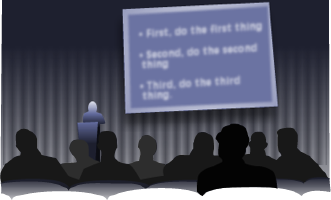
PowerPoint™ presentations are basic communication and teaching methods. How does a visually impaired person know what you are presenting? Or how does a deaf individual know about sound clips? When one puts together a presentation in this format one needs to know more than how to use the software to get one's ideas across. One must also prepare for the accessibility needs of others.
18 items: 5 internal 13 external

EqTD AUDIT
Use this AUDIT to evaluate the accessibility and usability of non-text graphics in a variety of media.
R2D2 Center at UW-Milwaukee


EqTD's for Graphic Elements - Why & Where
Equivalent text descriptions (EqTD's) are extremely important and can be difficult to create. Here you will find a set of EqTD related documents that detail processes, purposes and levels of complexity. The origin of providing alternative text for graphic elements and a brief review of the R2D2 standard are included.
R2D2 Center at UW-Milwaukee
Slide Show AUDIT
Use this accessibility measurement tool to create a slide show that is accessible to everyone. Font size is one important factor in slide accessibility.
R2D2 Center at UW-Milwaukee
Top 10 Tips for Accessible Slide Presentations
This posterette is a guide for making slide and PowerPoint Presentations with universal design for accessibility.
R2D2 Center at UW-Milwaukee
Writing Equivalent Text Descriptions (EqTDs) Posterette
This short 2-page document provides the essential "bare-bones" of what needs to be included in an equivalent text description (EqTD) and where the EqTD should be placed in a document. Whenever you create a document, whether it is electronic or paper, any non-text based element (e.g., picture, graph, "eye-candy") is not accessible to many individuals, so EqTDs should be provided.
R2D2 Center at UW-Milwaukee

Access Symbols
This link provides downloadable access symbols, provided copyright free, for closed captioning, descriptive video, and web access.
WGBH website
Accessibility of the Arts
This printable checklist addresses making the arts more accessible for people with disabilities.
National Endowment for the Arts
Accessible PowerPoint
This website is presented by Microsoft. This website includes documents on accessibility and creating accessibility. It contains ten documents that include not only "how", but also "why".
Microsoft
Accessible Tables
This webpage discusses the complexities of tables and how to make them accessible.
Jim Thatcher
Color
This website is everything you would want to know about color and accessibility. While this page was prepared for web accessibility, these issues also are relevant for print, poster, Power Point, etc. materials.
University of Minnesota Duluth
Creating Video and Multimedia Products That Are Accessible to People with Sensory Impairments
This website provides rationale, guidelines, and web links to assure that multimedia content is accessible for students with hearing or vision impairments. This website provides types of captioning and access for people that are blind.
Washington University DO-IT
Effective Color Contrast
This web page includes 3 general guidelines for making effective color choices that work for everyone when designing.
Lighthouse International
Equal Access: UD of Conference Exhibits & Presentations
From the Thursday afternoon workshop with Dr. Sheryl Burgstahler. This website provides a checklist of how to make conference exhibits and presentations welcoming, accessible, and usable.
Burgstahler, S. DO-IT, University of Washington
Fonts and Accessibility
This webpage discusses which fonts are the most readable and which are the most appropriate for web use. The different "font families" are compared and contrasted.
WebAIM
NCAM/Media Access Generator (MAGpie)
This webpage provides a list of free software authoring tools for making multimedia accessible to persons with disabilities. Guidelines, standards, and recommendations for accessible web and multimedia, as well as specific media rich examples are listed.
National Center for Accessible Media
NCDAE Tips and Tools: Microsoft PowerPoint
This document is intended as a discussion of accessibility and Microsoft PowerPoint. "This webpage discusses ways in which users have increased accessibility through the use of tools or workarounds that enhance PowerPoint accessibility to individuals with disabilities." Tables are provided which discuss specific accessibility challenges and their solutions. Methods and tools for converting PowerPoint slides to HTML are also provided.
National Center on Disability and Access to Education
PowerPoint Accessibility
This website discusses the possibility of posting a HTML- based version to increase accessible of a powerpoint. Frequently recommended on other UDE websites.
WebAIM
The Incredible, Accessible Presentation: Crafting PowerPoint Presentations That Work With Assistive Technology
This web page includes the steps to create an accessible PowerPoint presentation, from beginning to end. Tips and resources are included with easy-to-read directions for anyone.
Indezine