

Featured Entries
Know a good UDE website or resource?
Tools and Resources
Slide Presentations
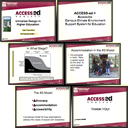
PowerPoint™ presentations range from introductory slides about UD, to models of UD, to specific instructional content for teaching UD implementation and skills.
5 items: 4 internal 1 external

Font Size for Accessible Media in the Classroom
These two Power Point slides provide a guideline to insure that the font size within print media are accessible when projected.
ACCESS-ed Project, R2D2 Center

Slide Show AUDIT
Use this accessibility measurement tool to create a slide show that is accessible to everyone. Font size is one important factor in slide accessibility.
R2D2 Center at UW-Milwaukee

Universal Design and Learning Centered Education
This Power Point presentation is packaged with the following goals: 1) understand the concepts of UD and LCE and how they are interrelated, and 2) utilize dynamic course design to integrate both concepts. It was initially developed as a DARC training module. Please note that the ppt file is labled "DRAFT" because some of the graphics do not have EqTDs written yet.
R2D2 Center at UW-Milwaukee
Universal Design In Higher Education
This Power Point presentation was developed as a basic DARC (Departmental Accessibility Resource Coordinator) training module.
R2D2 Center at UW-Milwaukee

The Future in Universal Design - Service Learning
This PowerPoint slide presentation used at a conference of the Association University Centers on Disabilities (AUCD), offers Universal Design within the context of Service Learning Projects. It addresses how can UD be applied to National Service and within the disability community and provides an example. Included in the presentation is an activity, "How do you move this beyond the physical to enhanced program design?"
Sue Lin, Project Director Karla Kmetz, Project Specialist for the Association University Centers on Disabilities (AUCD)